If you've ever wondered what holds window film to glass for years without peeling or bubbling, the answer comes down to adhesive technology — and which type your installer chooses matters more than most people realize.
Pressure Sensitive Adhesive (PSA) — The Professional's Choice
Pressure sensitive adhesive is exactly what the name suggests. When the liner is peeled back, the adhesive side has an immediate, gentle tack. The bond forms the moment it makes contact with the glass and pressure is applied.
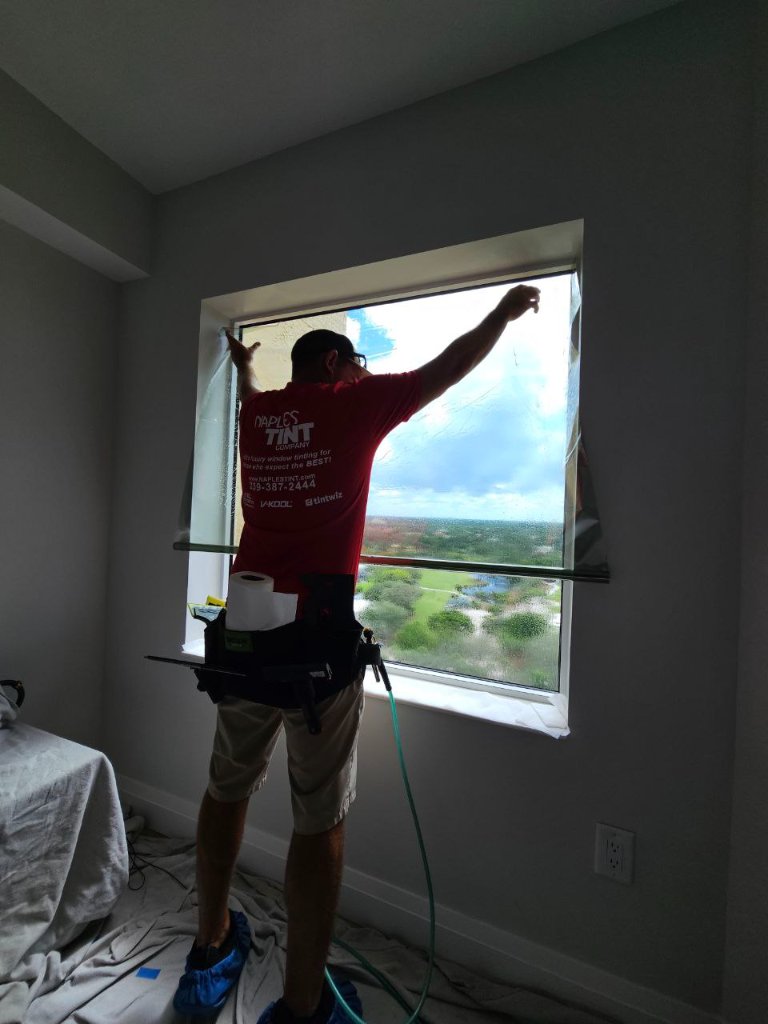
During installation, a slip solution of water and a small amount of soap is sprayed onto the glass first. This temporarily reduces the stickiness and gives the installer time to position the film precisely before squeegeeing out the water. Once the moisture is removed, the adhesive grips the glass cleanly and the film is locked in position.
PSA is the adhesive we use at Naples Tint Company for all of our installations — automotive, residential, and commercial. Here's why:
PSA performs consistently across all glass types
Whether it's the curved glass of a vehicle, a flat residential window, a sliding glass door, or a large commercial storefront, PSA forms a reliable, consistent bond every time.
PSA produces a clear, clean result
A quality PSA film installs with excellent optical clarity and minimal haze — which matters significantly on residential and commercial glass where you're looking through large, unobstructed panes every day.
PSA allows for clean future removal
This is one of the most important advantages that rarely gets discussed. Because PSA creates a mechanical grip rather than a chemical bond with the glass surface, it can be removed cleanly when the time comes — whether you're replacing the film after 10–15 years or removing it for any other reason. The glass comes clean without residue or damage.
- Immediate tack upon liner removal
- Bonds on contact with pressure applied
- Excellent optical clarity
- Works on all glass types and applications
- Clean, residue-free removal when needed
- Our adhesive of choice for every installation
Clear Dry Adhesive (CDA) — What You Should Know
Clear dry adhesive works differently. When you peel the liner off a CDA film, the adhesive side feels completely dry — not sticky at all. It activates with water during installation and then forms a chemical bond with the glass surface as it cures over days or weeks.
The idea behind CDA was that the chemical bond would be stronger and longer-lasting than a mechanical grip. In theory, the film becomes almost part of the glass itself as it cures. In practice, however, CDA has significant drawbacks that have led professional installers to move away from it.
CDA can produce haze and optical inconsistency
The chemical curing process doesn't always produce a perfectly clear result. In some conditions, CDA films develop a hazy appearance that never fully resolves — which is particularly noticeable on large residential windows where optical clarity is important.
CDA bonds are harder to control than they appear
While the chemical bond is strong, the strength can be inconsistent. Some panels bond better than others depending on temperature, humidity, and the specific glass surface.
CDA removal is significantly more difficult
This is the most practical concern. Because CDA forms a chemical bond with the glass rather than a mechanical grip, removal leaves adhesive residue on the glass that requires significant effort — and sometimes professional intervention — to clean completely. For residential and commercial clients who may eventually want to replace their film, update it, or sell their property, this is a real cost and inconvenience.
- Dry to the touch before installation
- Activates with water, cures chemically over time
- Can produce optical haze in some conditions
- Leaves adhesive residue on glass upon removal
- Less predictable than PSA on large flat glass
Why We Use PSA for Everything
The window film industry originally developed CDA for flat architectural glass on the assumption that the chemical bond would outperform the mechanical grip of PSA on large, stationary panes. But advances in PSA technology over the past decade have closed that performance gap while eliminating CDA's drawbacks.
Today's professional-grade PSA films match or exceed CDA performance on residential and commercial glass — with better optical clarity, more consistent results, and dramatically easier removal when the time comes. The chemical bond of CDA simply isn't worth the trade-offs in clarity, consistency, and future serviceability.
At Naples Tint Company, we've made a deliberate choice to use high-quality PSA films across all of our installations. It's the right adhesive for automotive glass. It's the right adhesive for your home. And it's the right adhesive for your commercial building.
What This Means for Your Installation
Whether you're tinting your car, your home, or your business, the adhesive is one of many variables that separates a professional installation from a budget one. The difference between a film that stays crystal clear for 15 years and one that develops haze or lifts at the edges often comes down to material quality — adhesive included.
When you work with Naples Tint Company, you get professional-grade PSA films installed by experienced technicians who understand the materials they're working with. If you ever want to know exactly what film we're recommending for your project and why, just ask — we're always happy to walk you through it.