You've done what any reasonable person does before spending money on a service. You got a second quote for window tinting on your vehicle. Now one is $200 cheaper and you're trying to figure out whether that gap means anything or whether you're being overcharged.
Here's the honest answer: sometimes the cheaper quote is a genuinely good deal from a competent installer using quality materials. More often, the gap reflects a real difference in what you're actually buying — and that difference shows up later, not at the time of installation.
This guide explains what actually varies between window tint quotes in Naples and what questions to ask before you decide.
The first thing to understand: quotes are often not for the same product
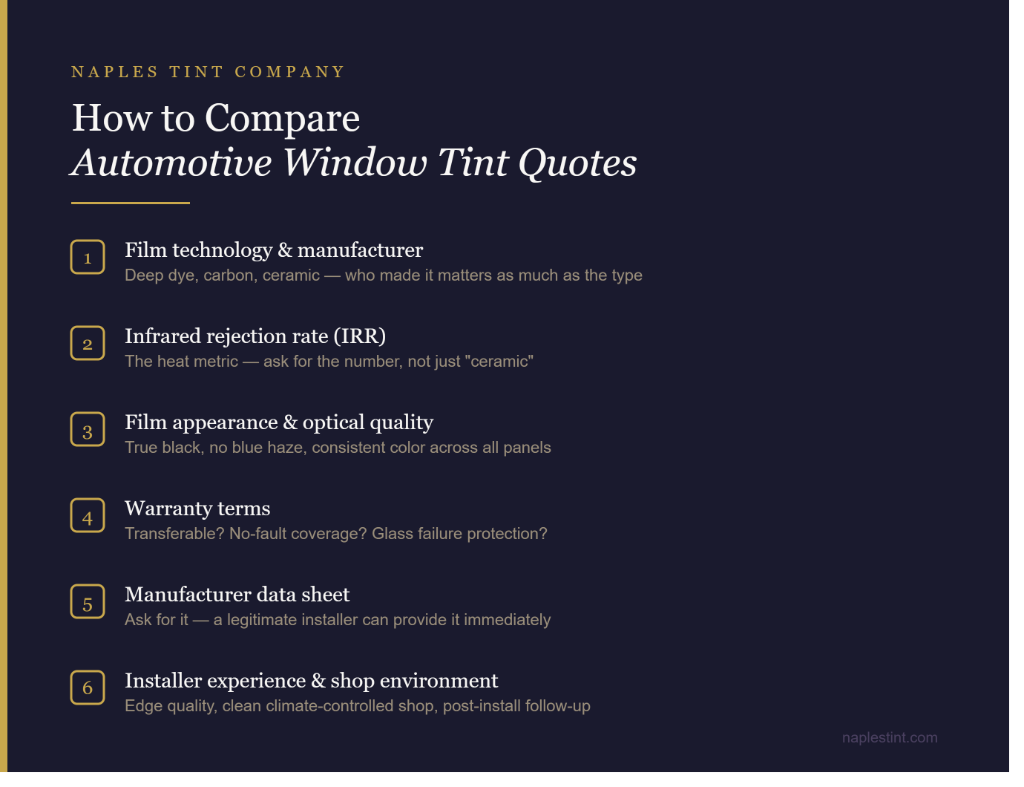
When you get two quotes for window tinting, you are frequently comparing two completely different products even when the installers use the same general language. Both might say "ceramic tint." Both might say "lifetime warranty." Both might quote the same darkness level.
What they don't tell you without being asked:
- Who manufactured the film
- How many nano-ceramic layers it has
- What the infrared rejection rate is
- What the warranty actually covers and whether it's transferable
- How long the installer has been doing this
Each of these factors affects what you're paying for and what you'll experience over the next 10–15 years.
Factor 1 — Film technology and manufacturer quality
Window tint falls into several categories by construction — but the category alone tells you less than most comparison guides suggest. What matters as much as the film type is who manufactured it and how.
Deep dyed film — a properly manufactured deep-dyed product from a quality manufacturer like Gareware, which produces film under the Autobahn brand, will sustain itself for a decade or more in Florida's climate. The performance difference between a quality deep-dyed film and a quality ceramic film comes down primarily to heat rejection, not longevity or appearance. Don't assume "dyed" means inferior — the manufacturer and construction determine the outcome.
Carbon film — often marketed as a step up from dyed, but in practice this category is inconsistent. Many carbon films are supplemented with dyes that color shift over time. The carbon particles themselves can create a hazy appearance when sunlight hits them at certain angles. Carbon film products are frequently paired with lower-quality adhesives that perform poorly over time. The "carbon" designation tells you less about quality than the manufacturer behind it.
Ceramic film — uses nano-ceramic particles that block infrared heat at the molecular level without fading, color shifting, or interfering with GPS, Bluetooth, cameras, or radar. Superior heat rejection compared to dyed or carbon at equivalent construction quality. The right choice for vehicles prioritizing maximum heat rejection in Florida's climate.
The practical takeaway: ask the manufacturer name, not just the film type. A quality deep-dyed Gareware product outperforms a budget carbon film with supplemented dye and a poor adhesive. Technology category is a starting point, not a conclusion.
Factor 2 — The specific film and its infrared rejection rate
"Ceramic" is not a performance specification. It's a category. Within ceramic window film there is a wide range of performance, and the number that matters most is Infrared Rejection Rate (IRR) — the percentage of infrared radiation, the heat component of sunlight, that the film blocks.
IRR does not change based on how dark the film is. A film that rejects 60% of infrared at 5% darkness also rejects 60% at 35% darkness. The shade determines how much visible light passes through. The ceramic layer count determines how much heat is rejected.
To illustrate with a product line we carry: Autobahn's ceramic lineup at the same darkness level ranges from 60% IRR in the single-layer Black Ceramic to 93% IRR in the three-layer i3 to 99% IRR in the four-layer i3+. These are not minor differences. A car with 99% infrared rejection will feel dramatically cooler than one with 60% — regardless of what both are called.
When comparing quotes, ask each installer: what is the IRR of the film you're quoting, what manufacturer makes it, and can you provide the technical data sheet? A legitimate installer with quality film can answer all three immediately.
Factor 3 — Film appearance and optical quality
Not all window films look the same after installation.
True black color — quality ceramic films install with a neutral, consistent black appearance at all viewing angles. Lower-quality or poorly constructed films can show color inconsistency — a blue or purple cast visible at certain angles, particularly noticeable on dark vehicles and across multiple window panels where any variation stands out.
Optical clarity — the film should be perfectly clear, with no haze, no distortion, and no trapped air. Bubbles, haziness, or edge lifting shortly after installation are signs of either poor-quality film, poor installation technique, or adhesive problems.
Factor 4 — Warranty terms
"Lifetime warranty" appears in the marketing of virtually every window tint product at every price point. The terms behind that phrase vary considerably. Ask these specific questions:
- What does it cover? A complete warranty covers discoloration, cracking, blistering, bubbling, peeling, demetallizing, and delamination.
- Is there a no-fault provision? Quality film manufacturers include coverage for accidental damage — a seatbelt chip, a key scratch — up to up to $350 toward one window (amount varies by film tier — $150 for Black Ceramic, $250 for Ceramic i3, $350 for Ceramic i3+)
- Is it transferable? If you sell your vehicle, does the warranty transfer to the new owner? Autobahn's warranty includes a transferable option for a $99 transfer fee. Many budget warranties are non-transferable.
- Who services it? The warranty must be honored by an authorized dealer facility. If the shop loses its authorization, who handles claims?
- Does it include glass failure coverage? Some premium warranties cover non-impact-related glass damage — stress fractures, manufacturer defects — up to a per-vehicle maximum.
Factor 5 — Installer experience and environment
Two installers using the same film will produce different results based on their experience level and installation environment. Window tinting is a precision craft — the film must be cut exactly to each glass panel, applied without contamination, and squeegeed without leaving water pockets or air bubbles. Edge quality directly reflects installer skill.
Things worth evaluating: how long has the installer been working; what does their shop look like — a clean, climate-controlled environment produces better results than an uncontrolled space; can you see examples of their installed work; and do they follow up after installation to confirm the result meets expectations.
Questions to ask any installer before booking
- What specific film are you quoting — manufacturer and product name?
- What is the infrared rejection rate (IRR) of that film?
- Can you provide the technical data sheet?
- What does the warranty cover specifically, and is it transferable?
- Is there a no-fault provision and what does it cover?
- How long have you been installing window film?
- Where is the installation performed — can I see the shop?
An installer quoting quality film at a fair price can answer every one of these questions directly and specifically. Vague answers — "it's the best film available," "our warranty covers everything" — are not answers.
What the price gap usually reflects
In our experience installing window film in Naples for over 20 years, the most common sources of a significant price gap between quotes are:
- Film tier — a carbon film quote versus a ceramic film quote. Both legitimate, not equivalent products.
- Ceramic layer count — a single-layer ceramic quote versus a three or four-layer ceramic quote. Same word, very different performance.
- Warranty depth — a basic lifetime warranty versus one with no-fault, glass failure, and transferable coverage.
- Installer experience — a lower-volume shop or newer installer versus an established operation with volume and technique.
If the cheaper quote is for a different film tier or a less complete warranty, the price difference is real and justified. If both quotes are genuinely for the same product tier from comparable installers, the lower number may simply be a better deal. The only way to know is to ask.
Frequently asked questions
Should I always choose the more expensive quote?
No. Price alone tells you nothing. A higher quote with vague film specifications and a limited warranty may represent worse value than a lower quote from an experienced installer using quality material. Evaluate what each quote actually includes.
Is a $150 price difference significant?
It can be. On a sedan, $150 is roughly the difference between a single-layer ceramic and a three-layer ceramic film — a meaningful performance gap in Florida's climate. On the other hand, $150 between two quotes for the same film tier from comparable installers is probably not worth much analysis. The question is what the $150 buys.
How do I know if a film is actually ceramic?
Ask for the technical data sheet from the manufacturer. Ceramic films will specify the ceramic particle technology in their construction. If an installer cannot or will not provide a data sheet for the film they're quoting, treat that as information.
What is the most important performance spec to compare?
Infrared Rejection Rate (IRR). This is the percentage of infrared heat the film blocks. It does not change with VLT shade level — it is determined entirely by the film's construction. Two quotes both claiming "ceramic tint" at the same darkness can have IRR values that differ by 30–40 percentage points. In Southwest Florida's climate, that difference is felt every time you get into your car.
Do all window tint warranties cover the same things?
No. Ask specifically what is covered, what the exclusions are, whether there is a no-fault provision, and whether it is transferable. "Lifetime warranty" without these details is a marketing phrase, not a commitment.