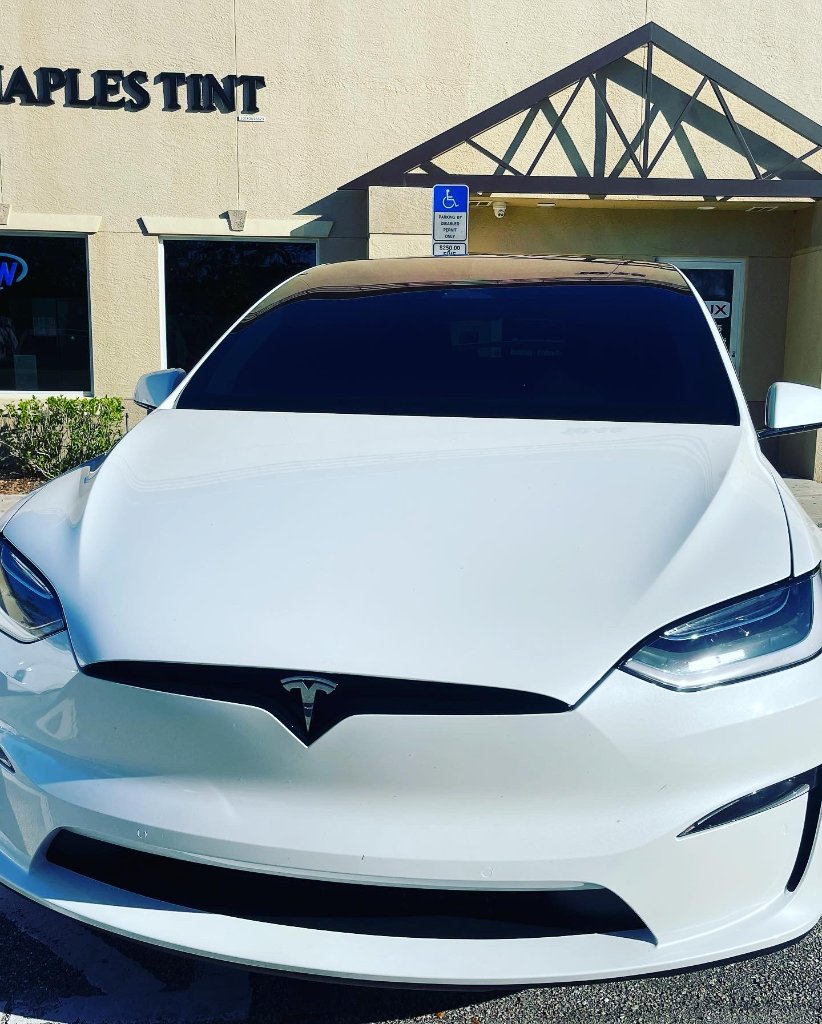
Tesla vehicles are in a category of their own when it comes to window tinting — and not every shop is equipped to handle them correctly. The cameras, sensors, and software that make a Tesla a Tesla are built into and around the glass in ways that standard tinting approaches can compromise. Done right, a Tesla tint job is one of the best upgrades you can make to the vehicle. Done wrong, it can interfere with Autopilot, cameras, and connectivity in ways that are difficult to undo.
Here's what you need to know before tinting any Tesla in Southwest Florida.
Why Tesla Is Different From Every Other Vehicle
Most vehicles have relatively straightforward glass — side windows, a rear window, and a windshield. Tesla changed that significantly.
Every Tesla built since 2017 has cameras embedded in or around the glass: front-facing cameras mounted at the top of the windshield, side repeater cameras in the B-pillars, and rear cameras visible through the rear window or tailgate glass. The Model 3 and Model Y have full glass roofs that cover most of the passenger cabin. The Model S and Model X have panoramic sunroofs with large glass surface areas. The Cybertruck has a massive windshield that sweeps back at an aggressive angle.
All of these cameras work in concert with Tesla's Autopilot and Full Self-Driving software, which relies on unobstructed visual data to function correctly. Any film that interferes with the cameras' ability to see clearly — whether through reflectivity, haze, or signal interference — creates a real problem.
The Film Selection Problem: Why Most Window Tints Are Wrong for Tesla
Standard window tint falls into three categories: dyed film, carbon film, and metallic film. Dyed and carbon films are relatively safe for Tesla's electronics, though neither offers the best heat rejection performance. Metallic film — which contains actual metal particles and has historically been marketed as a premium heat-rejection option — is a genuine problem.
Metallic particles in window film can interfere with:
- Autopilot camera image quality
- Cellular connectivity (used for over-the-air software updates, navigation data, and Tesla's remote features)
- GPS signal reception
- Bluetooth and WiFi
- The radar and ultrasonic sensors that support Automatic Emergency Braking and other safety features
Tesla themselves advise against metallic window tint in their owner documentation. In Southwest Florida's climate, where the instinct is always to get the highest heat rejection film possible, this creates a real conflict — the most aggressive metallic films also happen to be the most problematic for Tesla's technology.
The solution is ceramic film.
Why Ceramic Film Is the Only Responsible Choice for Tesla
Ceramic window film uses nano-ceramic particles rather than metallic ones. It blocks infrared heat and UV radiation at the molecular level without any metallic content — which means zero interference with cameras, radar, GPS, or any of Tesla's connectivity features.
The performance is also genuinely excellent. Quality ceramic film blocks up to 80% or more of solar heat and up to 99% of UV rays. In a Tesla with a large glass area, that heat rejection matters enormously on Florida's roads. We install the Autobahn ceramic lineup — non-metallic, safe for all Tesla electronics, with infrared rejection rates from 60% on the Black Ceramic to 99% on the i3+ — on every Tesla we tint.
At Naples Tint Company, every Tesla installation uses Autobahn ceramic film — non-metallic, high-performance, and backed by a manufacturer warranty. We do not install metallic film on Tesla vehicles under any circumstances.
Tesla Models We Tint — What to Know About Each
Model 3 and Model Y
These are the most common Teslas we see in Naples and Bonita Springs. Both have a full glass roof extending from the windshield to the rear — on the Model Y this is a single panoramic panel, on the Model 3 a fixed glass roof panel.
For both models, the meaningful film work happens on the side windows, rear window, and windshield. The Autopilot cameras are positioned at the top of the windshield and in the B-pillars. Our installation approach accounts for these camera positions to ensure unobstructed sight lines.
Model S and Model X
The Model S and Model X have larger glass areas and more complex configurations than the 3 and Y. The Model X in particular has falcon wing rear doors with curved glass that require precise film application.
Both models have the full suite of Autopilot cameras and sensors. Ceramic film on all glass surfaces with clear ceramic for the windshield is our standard recommendation for both.
Cybertruck
The Cybertruck's stainless steel body and aggressive glass angles make it one of the most visually distinctive tinting jobs available. The windshield has a very low rake angle that creates significant solar exposure for the driver, and the side glass is large and relatively upright.
We tint Cybertrucks at our Bonita Springs location and have worked with the specific glass configurations and installation challenges unique to this vehicle.
The Glass Roof Question — What Most Shops Won't Tell You
This is where we part ways with a lot of the information you'll find online about Tesla tinting — and with what some shops in this market will tell you.
Tesla's glass roof on the Model 3, Model Y, and other models is not standard automotive glass. It's engineered with built-in infrared and UV protection from the factory. Tesla has invested significantly in this glass technology specifically because of the large surface area of the roof panels and the exposure to direct sunlight they create.
What this means practically: window film applied to the glass roof will not deliver the heat rejection benefits you're expecting. The factory glass is already handling the infrared and UV load.
The heat people feel when getting into a parked Tesla on a hot Florida afternoon is a different phenomenon entirely. The glass surface itself absorbs heat when the car sits in direct sun, and that hot glass then radiates thermal energy into the cabin. This is a conduction and radiation issue — not a light transmission issue. Window film cannot insulate the cabin from a hot glass surface. The glass is hot, and it will radiate that heat into the space below it regardless of whether film is applied.
So why do so many Tesla owners feel that roof tinting helped? Because they typically have the entire car done at the same time. The ceramic film on the side windows — where standard automotive glass allows significant infrared heat transmission — makes a dramatic, immediately noticeable difference in cabin temperature and comfort. Customers attribute the full improvement to all the film installed, including the roof, when the work is actually being done by the side windows.
We won't sell you something that won't deliver the benefit you're paying for. If you ask us about tinting your Tesla's roof, we'll tell you the same thing we're telling you here. The side windows, rear window, and windshield are where ceramic film makes a real, measurable difference on a Tesla.
Some shops in Southwest Florida will happily add the roof to your invoice without this conversation. We'd rather earn your trust with an honest answer.
What About the Windshield?
Florida law permits non-reflective tint on the windshield above the AS-1 line — the top few inches. Beyond that, many Tesla owners choose a clear ceramic windshield film and weigh their options with their installer.
Clear ceramic film is completely transparent — it adds no visible tinting and does not change the appearance of the glass in any meaningful way. What it does is block a significant percentage of infrared heat and up to 99% of UV radiation that would otherwise pass directly through the windshield onto the driver and front passenger.
In Florida, where driving with direct sun exposure is a daily reality, reducing that UV and infrared load through the windshield makes a noticeable difference in driver comfort and long-term sun exposure. It also does not affect Autopilot camera performance since it contains no metallic particles.
If windshield film is something you want to discuss for your Tesla, talk to us at your estimate appointment. We'll walk you through the options and give you a complete picture.
Florida Tint Law and Your Tesla
Florida's window tint law requires front side windows to allow more than 28% of light through and rear side windows and the rear window to allow more than 15% of light through. Every Tesla tint installation at Naples Tint Company is performed within Florida's legal limits. Every film we use is certified for Florida compliance.
Where We Install — Bonita Springs Location
All Tesla tinting is handled at our Bonita Springs shop at 28771 S Diesel Dr #4. We're open Monday through Friday 8AM–4PM. Appointments are preferred.
Our Bonita Springs location serves Tesla owners from Naples, Bonita Springs, Estero, Marco Island, and throughout Southwest Florida. Given the number of Tesla vehicles in this market, we've developed a specific approach for each model that accounts for the camera positions, glass configurations, and the particular challenges of Florida's UV environment.
Free estimates are available — calls only to (239) 397-2444.
Frequently Asked Questions — Tesla Window Tinting
Will window tint affect Tesla Autopilot?
Ceramic film, which contains no metallic particles, does not interfere with Autopilot cameras, radar, or any of Tesla's electronic systems. Metallic window film can cause interference and should not be used on any Tesla. We install exclusively ceramic film on Tesla vehicles.
Should I tint my Tesla's glass roof?
Tesla's glass roof already contains built-in infrared and UV protection from the factory. Adding window film to the roof will not deliver the heat rejection benefits most people expect. The heat you feel when entering a parked Tesla comes from the glass surface radiating thermal energy into the cabin — a physics problem that film cannot solve. The real improvement in cabin comfort comes from ceramic film on the side windows, where standard automotive glass allows significant infrared transmission. We will always give you an honest answer on this rather than add unnecessary work to your invoice.
What about tinting the full windshield on a Tesla?
Florida law permits non-reflective tint on the windshield above the AS-1 line. Clear ceramic film — which adds no visible tinting — is an option many Tesla owners discuss with their installer for its UV and infrared blocking properties. It does not interfere with Autopilot cameras since it contains no metallic particles. Talk to us at your estimate and we'll give you a complete picture of your options.
How long does Tesla tinting take?
A full tint on a Model 3 or Model Y typically takes 3–4 hours at our Bonita Springs shop. Larger vehicles like the Model S, Model X, or Cybertruck may take longer depending on the scope of the installation.
Does window tinting void Tesla's warranty?
Window tinting does not void Tesla's vehicle warranty. Ceramic film is non-invasive and does not affect any mechanical, electrical, or software components of the vehicle. If you have specific warranty questions, Tesla's customer service team can confirm this.
How much does it cost to tint a Tesla in Naples?
Pricing varies by model, glass coverage selected, and film tier. Contact us for a free estimate specific to your vehicle at our Bonita Springs location.