A Marco Island homeowner replaced their lawn with high-quality artificial turf — a common and practical choice for waterfront properties where saltwater intrusion, shade patterns, and maintenance demands make natural grass difficult to sustain. The result looked exactly as intended: a clean, green, low-maintenance ground cover alongside a dock and canal.
Within weeks, sections of the turf began showing burn marks. The damage appeared in a consistent linear pattern — not random, not from foot traffic, and not from any source on the ground. The cause was directly overhead and slightly behind: a west-facing window on the home's exterior, positioned at the precise angle to direct late-afternoon Florida sun onto the turf below.
The window was not curved. It was not a solar concentrator by design. It was simply a highly reflective Low-E window, west-facing, elevated above the turf — and in the afternoon hours when the sun moved into alignment with the window's reflective surface, the resulting beam was intense enough to damage synthetic grass.
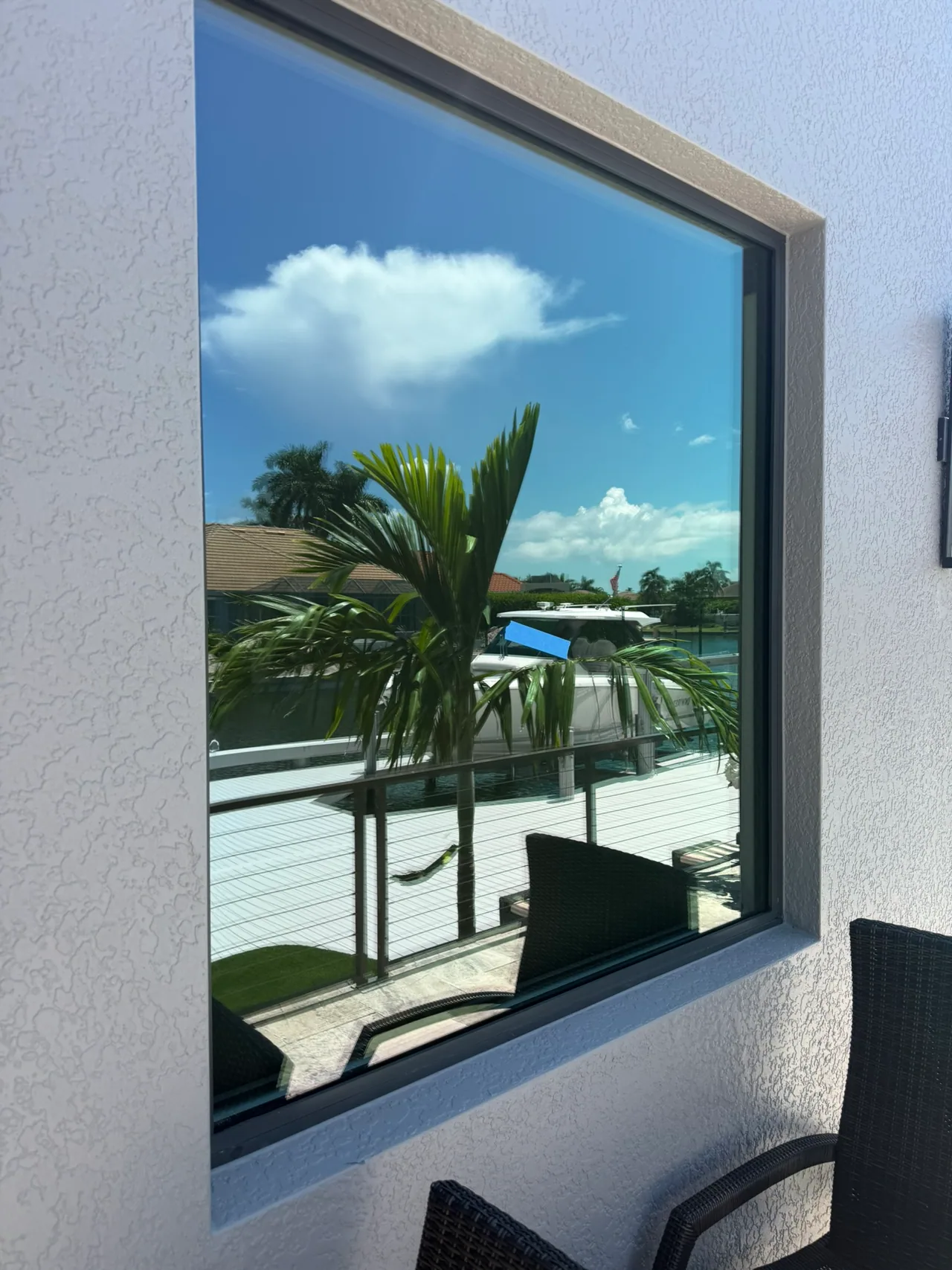
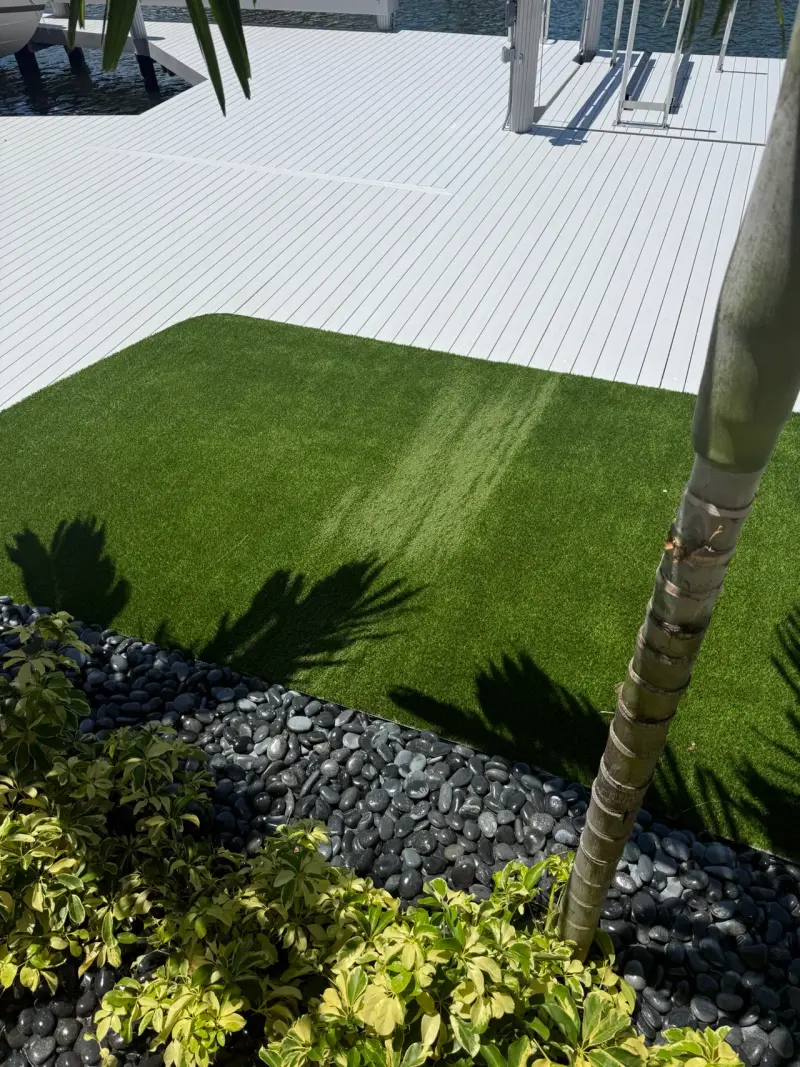
Why Reflective Windows Burn Artificial Turf
Low-E (low-emissivity) windows are engineered to reflect solar infrared energy away from the interior of the home. That is exactly what they are designed to do — and they do it effectively. The problem is that the energy reflected outward has to go somewhere. In most installations, the reflected beam disperses across a wide area and dissipates without consequence.
But geometry matters. A west-facing window elevated above a ground-level surface creates conditions where the afternoon sun — arriving at a low angle as it moves toward the horizon — strikes the window and reflects downward at a corresponding angle. If artificial turf, vinyl siding, a vehicle, or another heat-sensitive material lies in that reflected path, the concentrated energy can be significant.
Artificial turf begins to melt at approximately 175°F. Window reflections from Low-E glass have been measured exceeding 200°F at point of contact. The window does not need to be convex or curved to produce this effect — flat, highly reflective glass at the right orientation and elevation relative to the target surface is sufficient.
In Marco Island, the orientation, elevation, and afternoon sun angle combined to create exactly this condition. The damage pattern in the turf was not gradual — it followed the sun's movement through the afternoon window each day until the turf in the affected zone was replaced.
Why This Is an Exterior Film Problem
Interior window film would not solve this. The issue is the window's outward reflectivity — the energy is never entering the home, it is being reflected off the glass surface back into the outdoor environment. Applying film to the inside surface of the glass does nothing to change the window's behavior from the exterior.
The correct solution is exterior film — applied to the outside surface of the glass — which alters how the window handles solar energy at the point of contact. By reducing the window's outward reflectivity, an exterior film reduces the intensity of the reflected beam before it reaches the turf below.
This is a different problem than heat rejection for the interior of a home. It requires a different product, a different installation approach, and — because the film is exposed to outdoor conditions — a different film construction designed to withstand exterior weathering.
The Pre-Qualification Process
Naples Tint Company is an authorized Edge Film dealer. Before specifying or installing any film for a turf burn application, we initiated the pre-qualification process through Edge's dealer portal — a required step for projects where the Edge Turf Guard warranty will cover the installation.
Documentation
Photos of the affected window, the damaged turf, and the property orientation submitted through the Edge portal.
Technical Review
Edge evaluates the window type, orientation, and the nature of the reflected energy causing the damage.
Approval
Pre-qualification approval received within 15 minutes of submission on this project.
Installation & Registration
Edge Zën SSX 55 installed on the exterior glass surface. Warranty registered within 30 days of completion.
The pre-qualification step is not bureaucratic overhead — it is the mechanism by which Edge evaluates whether the specific installation is appropriate for the warranty coverage. A project where the film is installed without pre-qualification is not eligible for the Turf Guard warranty, regardless of the film used.
The Solution: Edge X Series Zën SSX 55
Edge X Series Zën SSX 55 is a spectrally selective exterior window film engineered specifically for applications where the window's outward behavior — its reflectivity — is the source of the problem. Applied to the exterior surface of the glass, it reduces the total solar energy reflected by the window without requiring dramatic visual change to the glass itself.
The outcome on this Marco Island project: The Zën SSX 55 softened the intensity of the reflected sunlight to a level below the threshold that damages artificial turf. The replacement turf installed after the film application has shown no further burn marks. The window's appearance changed subtly — the glass is slightly less mirror-like from outside — while interior views through the window are maintained.
Edge Zën SSX 55 — Performance Data
| Performance Metric | Value |
|---|---|
| Total Solar Energy Rejected (TSER) | 57% |
| Glare Reduction | 41% |
| UV Rejection | 99% |
| Application Surface | Exterior glass |
| Film Series | Edge X Series Exterior |
| Turf Burn Defense | Yes — pre-qualification required |
The Edge Turf Guard Warranty
Edge Turf Guard — Coverage Summary
- Coverage period: 5 years from installation date
- Maximum reimbursement: $1,000 per project
- What it covers: Turf damage caused by window reflection where Edge exterior film has been installed by an authorized dealer
- Pre-qualification: Required before installation — submitted through Edge dealer portal
- Registration deadline: Warranty must be registered within 30 days of installation
- Eligibility: Authorized Edge dealers only
The Turf Guard warranty matters because it demonstrates that Edge stands behind the film's ability to reduce reflected energy below the damage threshold. An installer who applies film to a turf burn application without going through pre-qualification is not offering this coverage — and the homeowner has no recourse if the film does not perform as expected.
Naples Tint Company's participation in the pre-qualification process on this project ensures that the Marco Island homeowner has both a solution and a warranty backing that solution for five years.
Frequently Asked Questions
Can a reflective window burn artificial turf?
Yes. Highly reflective windows — particularly those with Low-E coatings — can reflect concentrated sunlight at an angle and intensity sufficient to melt or burn artificial turf. The window does not need to be convex or curved. A flat, west-facing Low-E window at the right angle relative to the sun and the turf below can produce enough reflected energy to damage synthetic grass. This is a documented and growing problem in South Florida where west-facing waterfront homes combine Low-E glazing with artificial turf landscaping.
What window film stops turf burn from window reflections?
Exterior-applied window film is the correct solution. The film must be applied to the outside surface of the glass to reduce the window's outward reflectivity. Interior film does not address the problem because the reflected energy never enters the home — it bounces off the outside surface. Edge X Series Zën SSX 55 is specifically designed for this application and must be installed by an authorized dealer following pre-qualification with Edge to qualify for the Turf Guard warranty.
Does exterior window film change the look of the windows?
Edge Zën SSX 55 is spectrally selective and minimalist in appearance. It reduces glare and solar reflectivity while maintaining significant visible light transmittance. The visual change to the exterior is subtle — the glass takes on a slightly more uniform appearance without dramatically altering the look of the home. Interior views through the window are preserved.
How long does pre-qualification with Edge take?
Pre-qualification is submitted through an online portal. On the Marco Island project documented here, approval was received within 15 minutes of submission. The process requires photos of the affected window and turf, information about the window type and orientation, and details about the proposed installation. Naples Tint Company handles the submission as an authorized Edge dealer.
Does interior film work for turf burn?
No. Interior film does not affect the window's outward reflectivity. The reflected energy causing turf burn is bouncing off the outside surface of the glass — interior film installed on the inside surface has no effect on this behavior. Exterior film is the only film solution for reflective window turf burn.