Case Study · Baypointe Condominiums, Naples, FL
The Competitor's Ceramic Tint Made the Room 3 Degrees Hotter. Here's How We Proved It.
A Gulf-front condo in Baypointe. A failed ceramic film installation by another company. A client who had every reason not to trust another tinting company. And a FLIR camera that settled the debate.
Ceramic Film on Impact Glass — A Common Mistake With Measurable Consequences
The client had ceramic window tint installed by another company on the impact glass windows of their Gulf-front condo at Baypointe in Naples. They were told the film would make the room cooler. Instead, the room became 3 degrees hotter.
This is not an unusual outcome — it is the predictable result of installing the wrong film type on impact glass. Ceramic film works by absorbing infrared heat at the molecular level. On standard automotive glass in a moving vehicle, this absorption is manageable. On large impact glass panels in a Southwest Florida condo facing direct Gulf exposure, the absorbed heat builds in the glass surface and radiates back into the living space.
The glass was not cooler. The room was not cooler. The air conditioning was fighting harder than before the film was installed.
Earning Trust After Another Company Failed Them
When we were called in, the client had already paid for a window film installation that made their situation worse. They had every reason to be skeptical of any window tinting company's promises. We did not ask them to take our word for it. We proposed a demonstration they could see and measure themselves.
A Three-Film Test. A Thermal Camera. One Day to Prove It.
We began by removing the ceramic film from one panel on the right side of the window — leaving the ceramic film in place on the left panel as a live comparison. On the cleared right panel, we installed three 10-inch by 20-inch samples of the top spectrally selective films available — films that work by reflecting infrared radiation rather than absorbing it. The samples were positioned in a row across the upper portion of the glass. We returned the next day with a FLIR thermal imaging camera.
FLIR Thermal Evidence
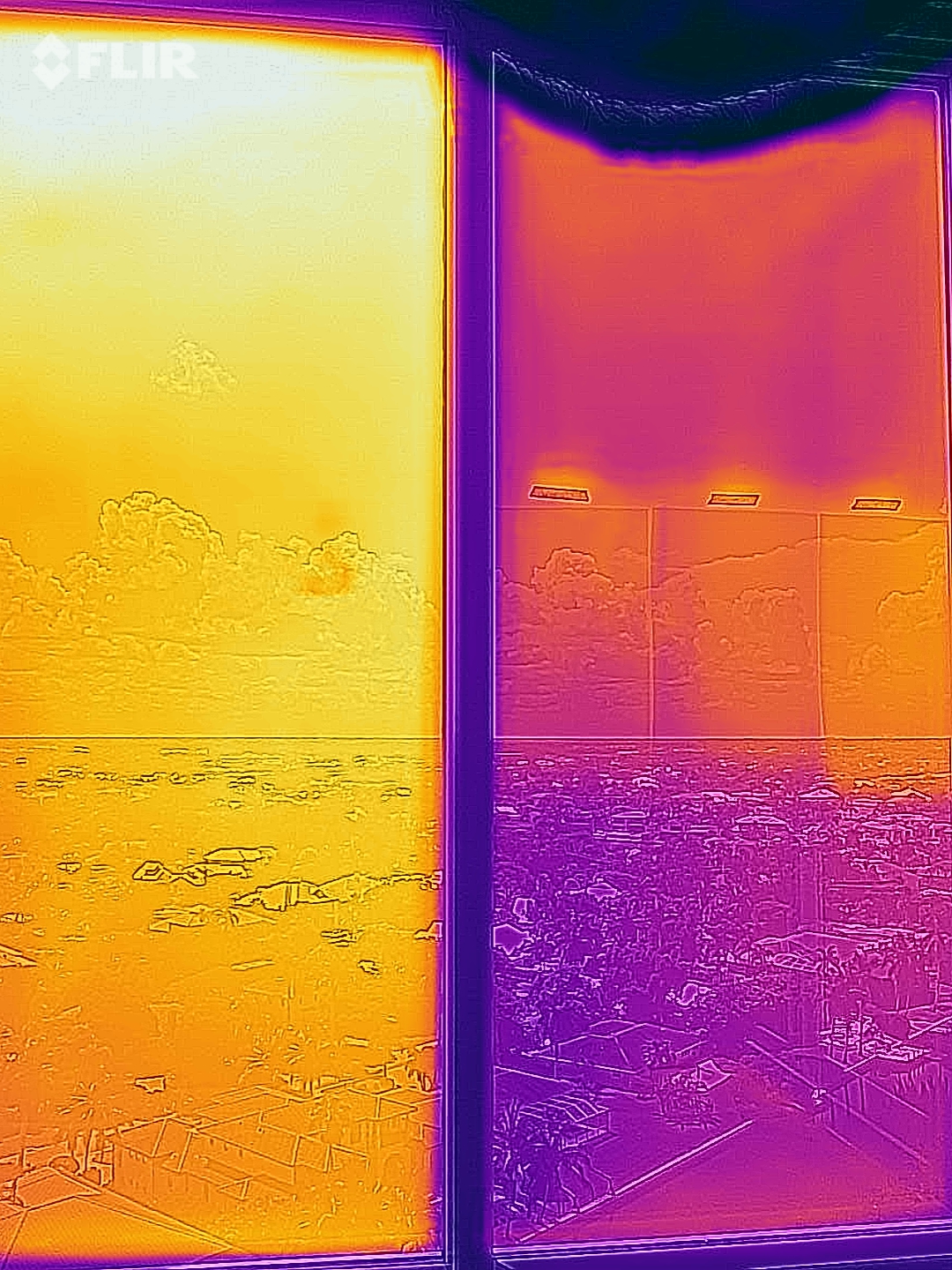
FLIR thermal imaging taken the day after the demonstration installation. Left panel: ceramic-tinted impact glass showing extreme heat absorption (orange/yellow = high heat). Right panel: cleared glass with three spectrally selective film samples installed. The three small rectangular samples in the upper portion of the right panel show dramatically reduced heat transmission (purple/blue = significantly cooler). V-Kool VK70 — the leftmost sample of the three — delivered the lowest heat reading of all films tested.
The Image Said What Words Could Not
The left panel — with the ceramic film still in place — appeared in intense orange and yellow on the thermal camera, indicating high infrared heat transmission into the glass and room beyond. The right panel, cleared of ceramic film and fitted with the spectrally selective samples, appeared in deep purple and blue — the thermal camera's indication of dramatically reduced heat transmission.
Of the three films tested, V-Kool VK70 delivered the lowest heat reading. VK70's XIR spectrally selective technology reflects infrared heat using a precious metal coating so thin it is optically invisible. It does not absorb heat. It does not raise the surface temperature of the glass. It simply prevents infrared radiation from entering the room. The client had seen the evidence themselves. No further convincing was required.
Every Panel. Every Window. V-Kool VK70.
We removed the ceramic film from every window in the condo and replaced it with V-Kool VK70 across all panels. The results were measurable within days. The room became 3 to 5 degrees cooler — because the air conditioning was now able to keep up with the solar heat gain through the glass. With ceramic film absorbing and re-radiating heat into the room, the HVAC system had been fighting an unwinnable battle. With VK70 reflecting the heat before it ever entered the glass, the system could do its job.
The Right Film for Impact Glass Is Not the Most Marketed Film
Ceramic window film is the most heavily marketed product in the automotive window tinting industry — and that marketing has created a widespread assumption that ceramic means best for every application. In automotive use on small tempered glass panes, ceramic film performs well. On large impact glass panels in Gulf-front condos, medical offices, and commercial buildings throughout Southwest Florida, it is the wrong product. The physics are different. The scale is different. The consequences are measurable.
V-Kool VK70 Specifications
- Visible Light Transmittance: 70%
- Infrared Rejection: 94%
- Visible Light Reflectance: 9%
- UV Rejection: >99%
- Technology: XIR spectrally selective precious metal coating
The 9% visible light reflectance is particularly significant for condo associations — it means VK70 does not change the exterior appearance of the building and does not trigger HOA architectural violations.
Concerned About Your Current Window Film?
If you have window film installed and your room is warmer than before — or your air conditioning is running more, not less — the film type may be the problem. This is diagnosable and fixable. We evaluate existing film installations and can tell you whether the film on your glass is working with your windows or against them. Free consultation for condo and residential owners throughout Naples, Bonita Springs, Marco Island, and Estero.
Call (239) 397-2444 · Schedule a consultation · Read our impact glass guide · HOA-compliant VK70 for Naples condos